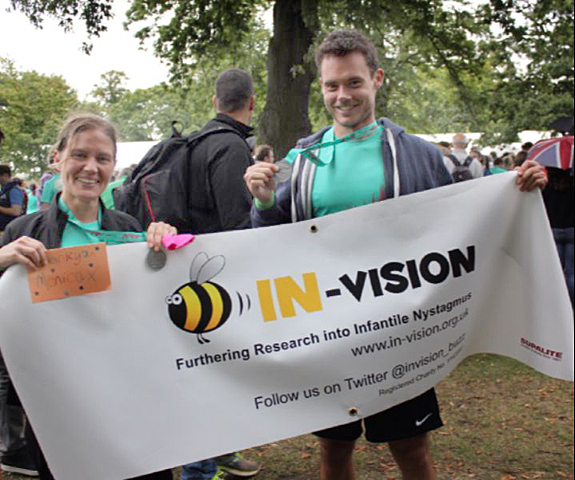
Launch of Eyelink funded by IN-vision

nystagmus image 2

Open Event: Introduction to the new eye Movement clinics at the Plymouth REI
Friday 25th April 2014

The REI at Derriford Hospital is please to announce the launch of a new service led by Prefossor Chris Harris.

The occasion is to be marked by a series of short talks by Professor Harris and members of the clinical team, including a demonstration of the Eyelinks Eye Tracker (equipment funded bt the nystagmus charity, IN-vision).

This event is possible thanks to the REI League of Friends.

This free event will take place between 13.00 to 16.00 in the Main Lecture Theatre, Post Graduate Medical Centre, Derriford Hospital.

For more information, contact the Orthoptic Department on or email

EyeLink 1000 Plus

IN-vision is pleased to announce the purchase of an EyeLink 1000 Plus, a new, sensitive and sophisticated eye tracking device, used by Universities and Hospitals worldwide to study normal and pathological eye movements.

This eye-tracker is one of the first of its kind to be used in the UK and Professor Chris Harris of the Plymouth Royal Eye Infirmary will use the equipment to set up a dedicated paediatric eye movement clinic to continue furthering research into nystagmus.

The EyeLink 1000 Plus is an ideal tool for nystagmus research because its state of the art features can capture eye movement simultaneously and reveal detail quickly – all without the need for patients to be stationary for long periods. It’s unique high speed allows for precise quantification of different types of waveforms, and maximises the potential to detect small changes in eye movements that may occur over time.

eylinkeyelink screenA target sticker is used which the camera can track as well as the eyes, meaning the subject is free to move about, making it a less stressful experience for young ones.

One of the reasons the Eyelink 1000 Plus was chosen was because not only can it be used in ‘head-fixed’ mode, it can also be used without stabilising the head. This, and it’s ability to track both eyes simultaneously, thus reducing the time required to obtain a full assessment, and it’s speedy data capture, make it ideal for use on infants and young children.

Professor Harris said: “The plan is to collect nystagmus waveforms from patients of any age. The goal is to examine how waveforms evolve with age (depending on any underlying diagnosis). This is part of our developmental programme to understand nystagmus at its onset in infancy. We will continue to record nystagmus from older patients to better understand the developmental trajectory. For us to be successful, we do need to see as many people, of all ages as possible.”

Liz Charter, co-founder of IN-vision believes that early diagnosis and referral from GPs is key to the success for improved treatment of nystagmus. She said: “we are very proud to have raised over £22,000 to purchase this very special piece of equipment for Professor Harris. We are extremely grateful to all of those who helped and especially the Robinson family and Tim’s Fund. Work starts now on raising funds for the next tracker so we can place these around the country.

It’s important now that Professor Harris gets the opportunity to use this sophisticated tracker on as many people as possible, especially infants. Not only will families be helping further research – they will also come away with a good insight into their particular variation of nystagmus. The best way to see Prof Harris, is to request a referral from their GP, or contact us and we will help.”

Notes: EyeLink eye tracking systems are made by SR-Research in Canada. Over 3200 research papers citing Eyelink trackers have been published.

Professor Chris Harris is Professor of Neuroscience at Plymouth University and specialises in visual development and eye movement disorders. Referral letters should be addressed to Prof Harris at Ocular Motility, Royal Eye Infirmary, Plymouth
Hospitals NHS Trust, Derriford Road, Plymouth, Devon, PL6 8DH

Tim’s Fund was set up in memory of Tim Robinson, supporting children with special needs achieve their potential.

IN-vision’s Medical Adviser interviewed by Radio Solent

IN-vision’s Medical Adviser Jay Self, Consultant Paediatric Ophthalmologist at the University Hospital in Southampton, has been busy lately. Not only has he signed up to at his hospital he has also been speaking out for nystagmus patients. He was interviewed by Radio Solent and many regional press covered the piece, as well as The Independent. All great news for raising awareness.

The full article is below.

EXPERT WARNS CHILDREN WITH DISABLING SIGHT PROBLEM ‘BEING WRITTEN OFF’

A leading eye specialist has warned thousands of children with a disabling sight disorder are being “written off”.

Jay Self, a consultant paediatric ophthalmologist at Southampton Children’s Hospital, said simple interventions used to improve the lives of patients with nystagmus continued to be overlooked.

The condition causes the eyes to wobble and creates strobe vision, which makes it difficult to see moving objects, recognise familiar faces or perform everyday activities such as playing with toys and friends.

Although nystagmus, which affects around one in 1,500 people in the UK, can develop in later life, it is more commonly found in babies and young children – known as congenital nystagmus – and can be caused by many different underlying conditions. While there is currently no cure, just under half of sufferers can be treated for associated problems to help ease their symptoms – but, for more than 50%, there are no other medical conditions to treat, which is when, according to Mr Self, doctors can “run out of ideas”.

“Nystagmus is a complicated condition to treat, with some isolated cases, some patients with other eye diseases and some with systemic or neurological disease,” he explained.

“So it is understandable doctors will focus on diagnosing associated diseases and excluding treatable causes as a priority, but that does not mean the rest should be simply written off.”

Mr Self said many who are unable to receive treatment can be helped in a variety of simple but important ways, including simply fitting them with the correct and regularly updated glasses or contact lenses or sitting them on the correct side of the classroom. “A significant part of the visual problems encountered by children with nystagmus is because of astigmatism and refractive error, which can be corrected with glasses or contact lenses,” said Mr Self, a senior lecturer in ophthalmic genetics at the University of Southampton.

“Similarly, children with nystagmus often have a direction of gaze in which the eyes move less rapidly and they can see more clearly, so simply advising schools to sit the child on the correct side of the class can have a profound effect on their ability to learn.” He also suggested doctors should carefully assess if a child has a preferred head position to see more clearly and seriously consider registering young patients with a Certificate of Visual Impairment (CVI).

“If a child has to hold their head in a very eccentric position to achieve better vision, then surgery can be offered to re-align this preferred position into central gaze,” he said.

“Even if surgery isn’t a possibility, registering children with a CVI, even when their best, static visual acuity is reasonable, can impart a wide range of benefits which are easy for doctors to overlook.”

He added: “The children we see in clinic today with nystagmus will be working age for 50 years or more, so can we afford to disregard them as being beyond help?”

For more information, email or call .

Press release issued by University Hospital Southampton NHS Foundation Trust – 17 February 2014

Marlow Riders Support IN-vision

IN-vision stand RKR


IN-vision is very grateful and proud to be one of the charities supported by the second annual . The cycling sportif took place in September and riders passed through the Chilterns and scenic Vale of Aylesbury.

The event was a sell out with almost 600 participants taking part along three different routes through the beautiful Bucks, Berks and Oxfordshire countryside. Director Steve Tolmie said it was a ‘huge success’ with more than £8000 raised.

IN-vision had a stand on the day, and handed out water and flapjacks as the riders crossed the finishing line. Ray O’Connor, IN-vision Trustee, said he felt elated that the charity had been chosen as one of three local charities being supported. He added, “it’s a great way for us to raise awareness and fantastic to be part of such an inspiring and impressive event hosted by the Marlow Riders.”

The share of money raised going to IN-vision will go directly to supporting research into the development of infantile nystagmus in infants. The funds will go towards the purchase of a sophisticated eye-tracker for use in a paediatric eye-movement clinic in southern England.

Run to the Beat

Run to the Beat.doc


Monica Manzinni, working in advertising and based in North London, took part in Run to the Beat, London’s half marathon in which participants run to a soundtrack of motivational tunes along the course, in September to raise funds for IN-vision.

Monica exceeded her own expectations and finished in an impressive time – in just over 2 hours – despite the gruelling hill finish into Greenwich Park. The team at IN-vision were there to cheer her on at the 11-mile marker.

“I had a great run apart from a small bottleneck that added about 5 minutes to my time,” she said. “The atmosphere on the day was fantastic,” she added. “I wanted to run for IN-vision because my good friend’s son has nystagmus and watching her struggle to find the necessary support for him, especially in the early days, was so difficult. I needed a personal challenge and thought that running and raising money for a charity whose purpose is to help find ways to improve their lives was a way I could help them, and maybe other families like them, too.”


monica-at-finish


Monica raised over £300 for IN-vision and we now have enough funds to purchase a high quality eye-tracking system for use in southern England. “This equipment will not only enable the establishment of a dedicated paediatric eye-movement clinic in the South, but will also greatly enhance research,” said Liz Charter, Chair of IN-vision.

We are extremely grateful to Monica for all the hard work she put into training and running this half marathon to support us.

Early cataract surgery does not affect development of nystagmus

Young, Heidary and VanderVeen present reports of 56 infantile cataract surgeries in J AAPOS. Their results show that ‘early’ cataract surgery (performed before 8 weeks of age) does not prevent the development of INS. This was previously reported as a comment in J AAPOS in 2011.

.

Optical coherence tomography review article

The journal Strabismus recently published a review article concerning the recent advances in the nystagmus literature brought about through the use of optical coherence tomography.

The review can be found .

Changes in pallisade endings of extraocular muscles with IN

A recent study has found significant differences in the palisade endings of the extraocular muscles of patients with IN. The results are published in the Chinese Journal of Ophthalmology and can be found .

No change in smooth pursuit target acquisition following tonotomy and reattachment

Work published in the Journal of Pediatric Ophthalmology and Strabismus shows in three patients that, despite other benefits of the treatment, tenotomy and reattachment does not improve the speed of acquisition to moving targets.

.

Botox in INS during infancy

The Spanish journal Archivos de la Socifdad Española de Oftalmología describes the use of botulinum toxin in a five month old patient with INS ond oculocutaneous albinism. They report reduced nystagmus amplitude and improved visual acuity. Long-term effects are not yet known.

At present the article is only available in Spanish – at PubMed.