IN-vision
Furthering Research into Infantile Nystagmus (IN)
Registered Charity
Acquired
Acquired nystagmus describes any form of nystagmus not developing in early infancy (unless caused by a lesion). Nystagmus that develops later in life often leads to the illusion of visual motion (oscillopsia). The animation below illustrates oscillopsia:

Gaze evoked nystagmus
Gaze evoked nystagmus appears as jerk nystagmus induced upon deviation of the eyes away from the primary position (straight-ahead).
In the primary position the usual presentation is of unsteady fixation but sometimes pendular nystagmus can also be observed. In lateral gaze positions a horizontal nystagmus will appear; in upgaze, upbeat nystagmus may appear, but with a smaller intensity than the horizontal nystagmus. A downbeat nystagmus in downgaze can also be present but is much less common. In the oblique gaze positions an oblique nystagmus can occur but if the vertical gaze-holding circuitry of the visual system is unaffected then the nystagmus will be purely horizontal. The variation in nystagmus with gaze position is shown in the animation below.
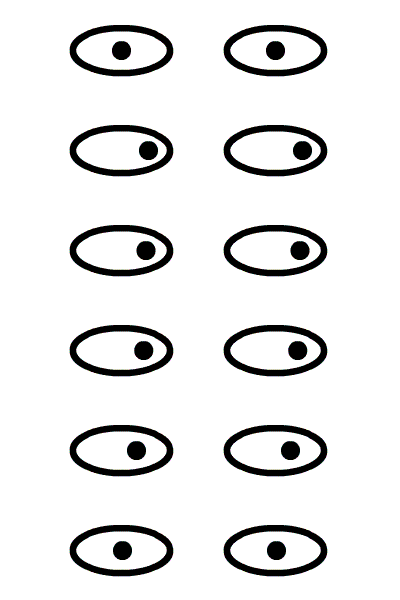
Gaze evoked nystagmus can be differentiated from FMNS by the absence of any change in the oscillations following the occlusion of one eye.
Gaze evoked nystagmus results from a mismatch between the gaze-holding systems and the movements of the extraocular muscles and can be linked to abnormal VOR, abnormal OKN and abnormal smooth pursuit.
Gaze evoked nystagmus can be caused by cerebellar disorders or follow the use of sedatives, anticonvulsants, alcohol, cannabis, barbiturates, diazepam or chloral hydrate.
Rebound nystagmus
Rebound nystagmus is a characteristic of gaze evoked nystagmus that is seen when the subject is asked to maintain an extreme lateral gaze position. In this situation the horizontal nystagmus intensity gradually decreases and sometimes even reverses its direction. If this is followed by a rapid return to the primary position, then the brief rebound nystagmus occurs. The rebound nystagmus lasts for only a short time and beats away from the direction of the maintained lateral gaze. Rebound nystagmus can sometimes be observed in subjects who also show end-point nystagmus.
Downbeat nystagmus
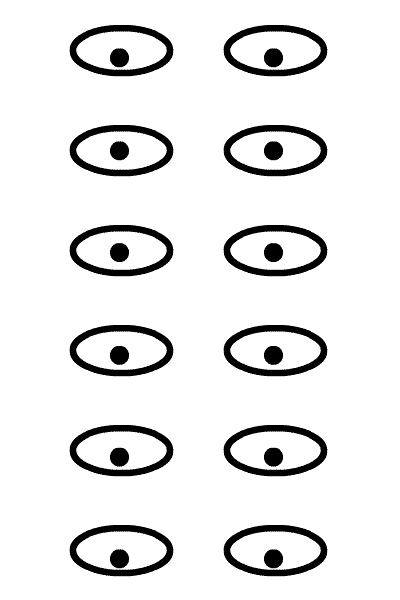
Downbeat nystagmus is most evident in the primary position. The nystagmus intensity increases in lateral gaze and the addition of a horizontal component results in oblique oscillations. The oscillations will often alter on upgaze but the changes are variable, they may reduce, intensify or change to an upbeat nystagmus. Downbeat nystagmus is affected by convergence which may result in an intensification of the oscillations, in fact downbeat nystagmus may only appear on covergence. Downbeat nystagmus can be accompanied by poor smooth pursuit, OKN and VOR.

Upbeat nystagmus
Upbeat nystagmus is less common than downbeat nystagmus and does not intensify in lateral gaze. The oscillations intensify on upgaze and reduce on downgaze although occasionally upbeat nystagmus can change to downbeat nystagmus on downgaze. Convergence also has an effect on the oscillations which can result in a cessation of the upbeat nystagmus or even change it to downbeat nystagmus.
Acquired pendular nystagmus
Acquired pendular nystagmus presents as a high frequency, low amplitude pendular oscillation as shown in the animation below.
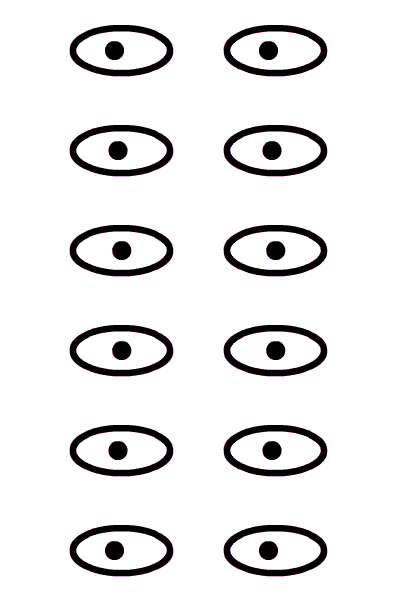
The direction of the oscillations is variable and can be horizontal, vertical, eliptical, circular, monocular or asymmetric. The oscillations usually remain pendular in all positions with only small changes in their amplitude. OKN response is still present. Acquired pendular nystagmus can present in young children resulting from dysmyelinating and demyelinating conditions. If the nystagmus is late onset, it can often be monocular or asymmetric and can follow visual loss or amblyopia.
Vestibular nystagmus
Vestibular nystagmus, as suggested by the name, is often associated with dizziness or vertigo. This can be brought about by various disorders that affect either the central nervous system or peripheral portions of the vestibular system. If a single semicircular canal in the inner ear is affected then the resulting nystagmus will occur in the same plane as the action of that canal.
The nystagmus itself is a jerk nystagmus and if caused by a peripheral vestibular disturbance it will quickly reduce due to the adaptation of the visual system. Differentiation between a central or peripheral vestibular abnormality can be determined due to the fact that peripheral vestibular nystagmus will intensify once visual stimuli are removed e.g. in the dark.
Positional nystagmus
This is a specific type of vestibular nystagmus which is indicated by episodes of vertigo which result from particular head movements. Positional nystagmus is associated with benign paroxysmal positional vertigo (BPPV) which is caused by deposition of degenerated material onto the posterior semicircular canal which then produces increased responses due to its increased mass.
Positional nystagmus can be initiated by moving the subject rapidly from a seated position to a head down position towards the side of the vestibular abnormality. The nystagmus will reduce and stop over a period of about 40 seconds.
Therapies
- Retinal image stabilisation
- Pharmacological treatments
Retinal image stabilisation
This technique uses a high-plus spectacle lens to place an image at, or close to, the centre of the eye’s rotation. The position of this focal point will therefore not be affected by the orientation of the eye. A high-minus contact lens is then used to bring this image into focus, as the contact lens moves with the eye it does not change the stability of the image. This technique can achieve a 90% stabilisation of the retinal image, unfortunately it also gives a small depth of focus and reduced visual field. As it also interferes with the VOR and prevents vergence movements (looking at objects at different distances) it can only be used monocularly.
Pharmacological
For a recent review of pharmacological treatments available for acquired nystagmus, the reader is directed to Mehta and Kennard (2012).