IN-vision
Furthering Research into Infantile Nystagmus (IN)
Registered Charity
Oscillation types
| Horizontal | The eyes oscillate horizontally |
| Vertical | The eyes oscillate vertically |
| Circumrotatory | The eyes oscillate horizontally and vertically at the same time. If these oscillations are in phase then the result is that the eyes move in an elliptical fashion |
| Oblique | The eyes oscillate horizontally and vertically at the same time but the oscillations are not in phase. This results in oscillations in an oblique direction |
| Torsional | The oscillations occur around the anteroposterior axes of the eyes resulting in torsional movements (i.e. the cornea will be seen to rotate clockwise and anti-clockwise) |
The direction of nystagmus is defined as the direction of the quick-phases relative to the head. This can cause some confusion, as in the majority of waveforms this means that the nystagmus ‘direction’ is actually the direction the eyes spend less time travelling in. As pendular nystagmus has no quick-phase it also has no direction. Some individuals exhibit periodic alternating nystagmus, in which case the beat direction changes over a regular time period.
Horizontal / Vertical
Horizontal nystagmus is by far the most common type; especially in early-onset nystagmus. Often, a small vertical component is also present in early-onset nystagmus, although purely vertical nystagmus is not unheard of, especially if acquired (see downbeat nystagmus and upbeat nystagmus).
Torsional
Torsional nystagmus describes oscillations about the anteroposterior pole of the eyes (as a result the iris is seen to rotate clockwise and anti-clockwise).
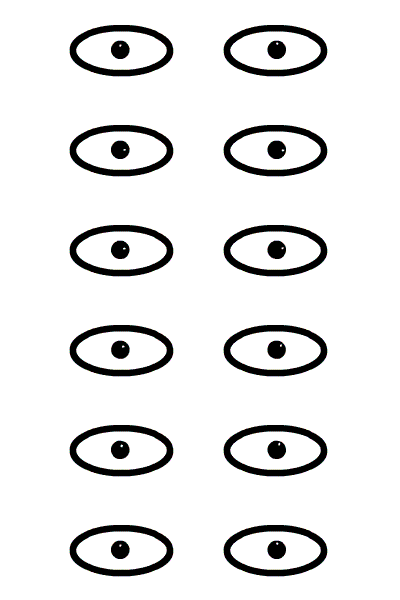
Tortional nystagmus as an isolated nystagmus is not common, however it is often seen in conjuction with other axes of oscillation in infantile nystagmus syndrome, fusion maldevelopment nystagmus syndrome, see-saw nystagmus and vestibular nystagmus.
Abduction
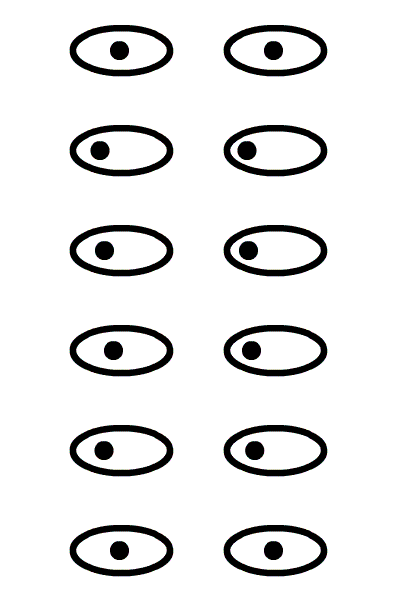
Abduction nystagmus appears on abduction (looking away from the nose); the resulting oscillations are asymmetric with there being a much weaker nystagmus observed in the adducting eye. This is shown in the animation below.
See-saw
The rare form of nystagmus known as see-saw nystagmus presents as oscillations in which one eye elevates and intorts (rotates towards the nose) whilst the other eye depresses and extorts (rotates away from the nose). These oscillations usually have a pendular waveform but can sometimes have a jerk waveform. The animation below shows see-saw nystagmus.
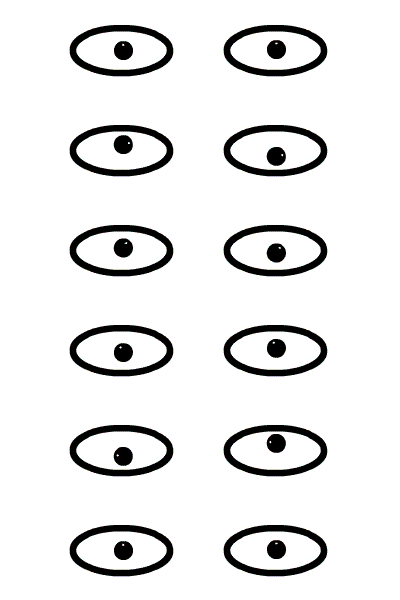
See-saw nystagmus can be congenital or acquired.
Periodic alternating nystagmus
Periodic alternating nystagmus (PAN) is a jerk nystagmus which will reverse direction every few minutes. PAN can be acquired condition or congenital and the oscillations themselves follow a repeating pattern of changes. The oscillations in the first direction gradually increase in intensity to reach a maximum level after about a minute. The intensity then begins to drop again and reaches a minimum intensity known as the neutral phase. The oscillations then begin again but in the opposite direction; each full PAN cycle taking approximately 3-4 minutes. A shortened version of a full PAN cycle is shown in the animation below.
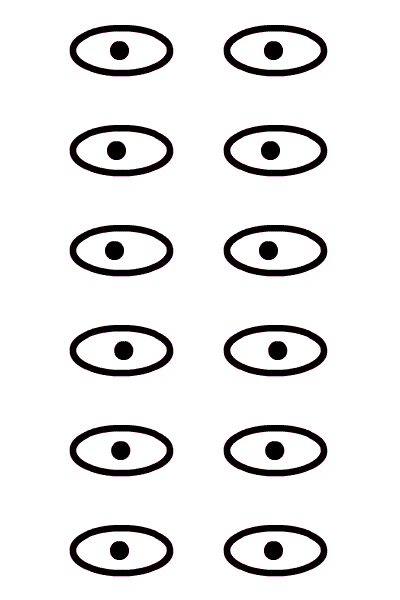
The duration of the PAN cycles can vary widely between subjects and in general congenital PAN consists of shorter cycles than acquired PAN. The time to reversal can also be different in each direction (asymmetric).