IN-vision
Furthering Research into Infantile Nystagmus (IN)
Registered Charity
Classification
Nystagmus is classified according to the observed characteristics of the resulting oscillations.
Waveform
The precise waveform (position-time relationship) of nystagmus can be recorded using eye tracking technology (a technique sometimes referred to as ‘electronystagmography’) which produces a graphical representation of the speed and direction of the oscillations. Nystagmus waveforms are typically visualised as shown below:

N.B. In horizontal eye movement recordings, an upwards deviation on the trace always indicates a rightward rotation of the eyes.
There are two major types of waveform:
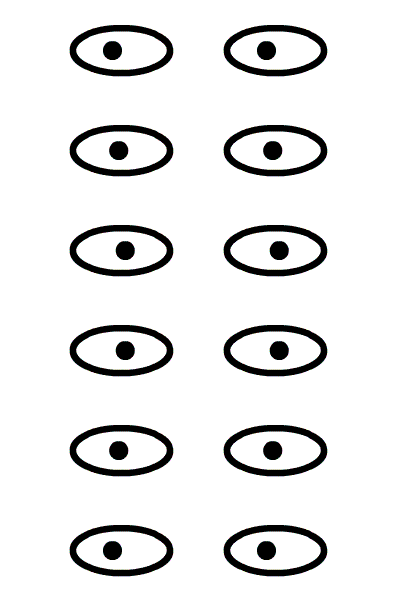
Jerk
The waveform has a long, slow movement of the eyes in one direction (slow-phase), followed by a short, fast movement of the eyes in the opposite direction (quick-phase).

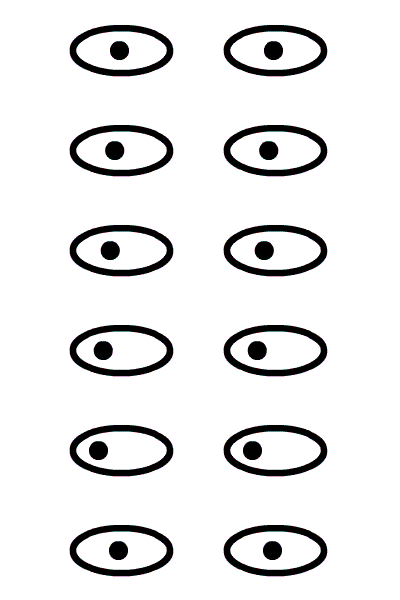
Pendular
The waveform has the same speed and amplitude in both directions.
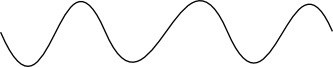
There are in fact 12 recognised waveforms in infantile nystagmus syndrome. These are shown below:
| Pure pendular | |
| Asymmetric pendular | 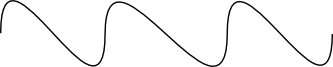 |
| Pendular with foveating saccades | 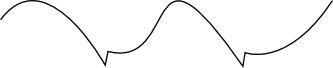 |
| Pure jerk | 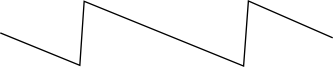 |
| Extended foveation | 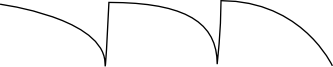 |
| Pseudo cycloid | 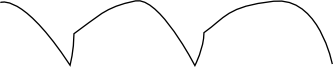 |
| Pseudo jerk | 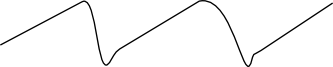 |
| Pure pseudo pendular | 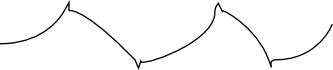 |
| Pseudo pendular with foveating saccades
(one saccade is larger) |
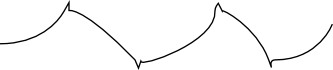 |
| Triangular | 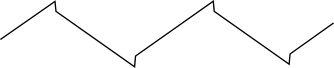 |
| Bidirectional jerk | 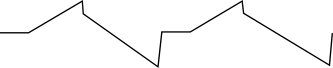 |
| Dual jerk | 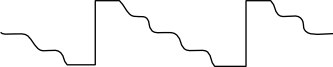 |
N.B. Although we often refer to nystagmus oscillations as ‘eye movements’, it is important to clarify that these ‘movements’ refer to rotation, rather than translation.
Direction
(See Oscillation types)
Amplitude
The angle through which the eyes rotate during the oscillation. Amplitude is measured in degrees.
Frequency
The number of full oscillation cycles that occur each second – measured in cycles per second (hertz).
Intensity
The product of the amplitude and frequency of the oscillations (amplitude and frequency multiplied together).
Manifest / Latent
All infantile nystagmus will fall into one of three categories:
| Manifest | Nystagmus is present with both eyes open and does not change intensity if an eye is covered |
| Latent latent | Nystagmus is only present when one eye is covered |
| Manifest latent | Nystagmus is present with both eyes open but becomes more intense if an eye is covered |
Effect of Gaze
| Gaze-evoked | Oscillations only appear if the eyes move from the primary position (straight-ahead) |
| Gaze-dependent | Nystagmus in which the oscillation waveform or intensity is altered by position of gaze |
Conjugate/Asymmetric
‘Conjugate’ indicates that the oscillations are synchronous and the same in both eyes. ‘Asymmetric’ or ‘dissociated’ refers to the case in which the oscillations differ between the two eyes. Note that nystagmus can still be conjugate in the presence of strabismus.
Compound
Describes the (common) case in which two types of nystagmus present in one patient, e.g. jerk and pendular. Often the waveform can change spontaneously, or when the angle of gaze is changed.
NAF, NAFX, ANAF, NOFF, NAEF
In an attempt to provide a measure of visual function in nystagmus that takes into account visual acuity, intensity and foveation quality, a battery of quantitative measures have been devised. Sheth et al. (1995) developed the nystagmus acuity function (NAF), which seeks to estimate the maximum potential visual acuity that an individual with INS or FMNS could achieve in the absence of co-existing pathology, given an improvement in the characteristics of the nystagmus parameters. The function depends on the individual being capable of maintaining eye movement velocities ≤4°/s during their foveation periods, as well as a foveation accuracy of ±0.5°. To address these limitations, the function was improved upon by the so-called ‘expanded nystagmus acuity function’ (NAFX), which allows for expansion of the position and/or velocity limits of the NAF, which are dynamically altered depending on the nature of the data being analysed (Dell’Osso and Jacobs 2002).
Recently, a new measure was developed – the automated nystagmus acuity function (ANAF). ANAF was devised in order to perform NAFX measurement more quickly and easily (Tai et al. 2011).
Further measures also exist:
- Nystagmus optimum fixation function (NOFF) (Felius et al. 2011)
- Nystagmus acuity estimator function (NAEF) (Cesarelli et al. 2000)